
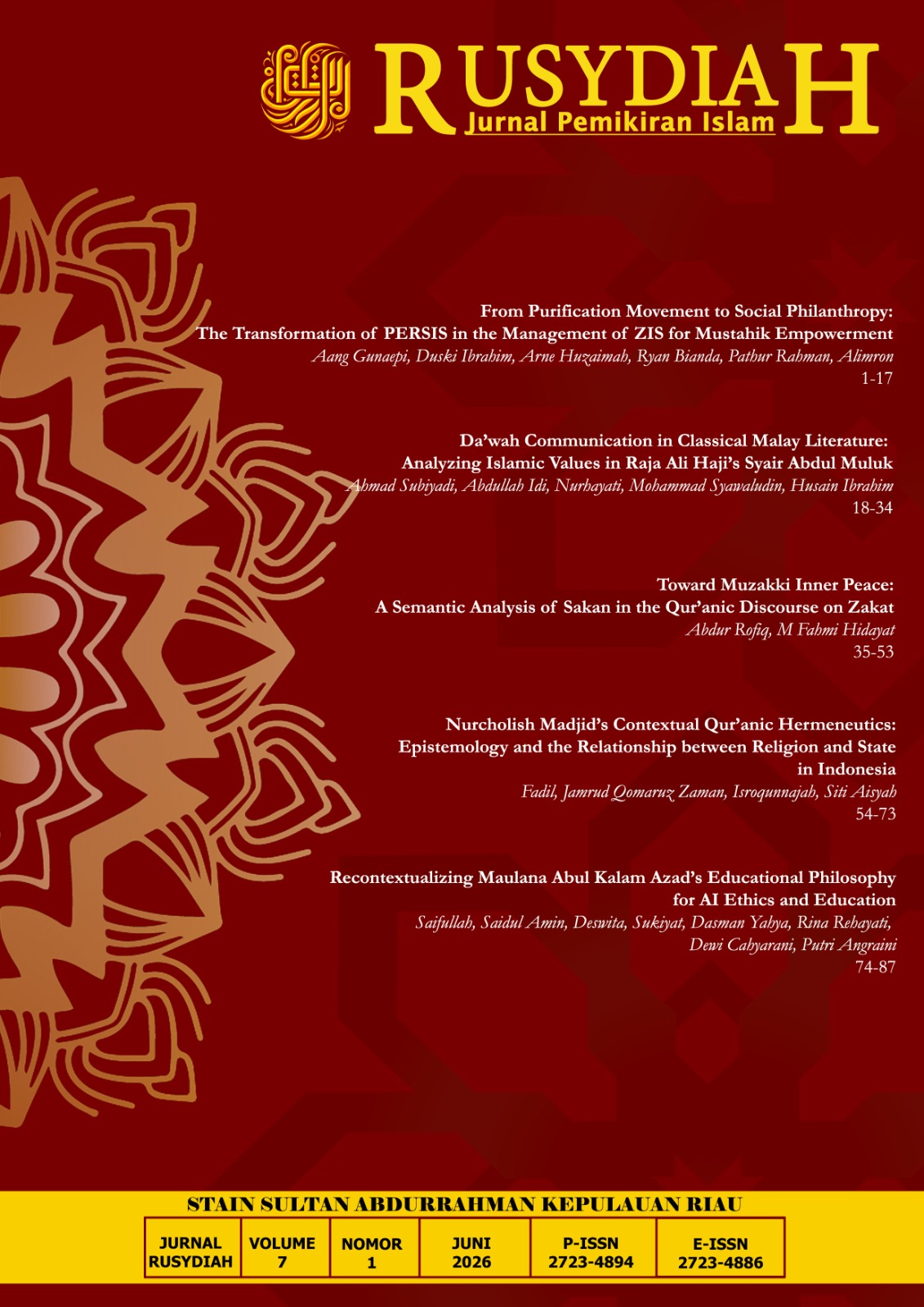
Da’wah Communication in Classical Malay Literature: Analyzing Islamic Values in Raja Ali Haji’s Syair Abdul Muluk
Article Sidebar
Main Article Content
Abstract
This study aims to analyze and formulate Raja Ali Haji’s cultural da’wah communication model developed through the integration of Islamic values and classical Malay literary traditions in the Syair Abdul Muluk manuscript (1,824 stanzas). Utilizing a descriptive qualitative method supported by historical, literary hermeneutics, and cultural sociology approaches, this research explores the theological content deliberately embedded within the narrative structure of heroic fiction. The results indicate that Syair Abdul Muluk integrates 12 pillars of Islamic values encompassing theological (creed/tawakkal), sharia (worship), and moral dimensions (just leadership ethics and sharia-compliant gender emancipation). The da’wah communication model in this text exemplifies a systematic cultural da’wah strategy, where literary aesthetics serve as a channel to soften religious doctrines, making them adaptive for a traditional Malay audience. This study also uncovers a text-purification function that corrects local syncretic practices, such as shifting the function of traditional offering rituals (sesajen) in the oral tradition of Dulmuluk performances toward sharia-compliant prayers for safety (doa selamat). The implications of this study reaffirm the vital contribution of 19th-century classical literature as a methodological foundation for contemporary da’wah that is persuasive, inclusive, and prioritizes moral excellence.
Article Details

This work is licensed under a Creative Commons Attribution 4.0 International License.
References
Abdullah, B. B., Ibrahim, A. Q. B., Dollah@Abdullah, A., Hafiz Bin Ab Latif, M. N., Bin Mohamad, M. Z., & Yusoff, Z. (2024). The Success of Da’wah in Integrating Islamic Values into the Cultural Heritage of Terengganu. International Journal of Academic Research in Business and Social Sciences, 14(12), 3353-3365. https://doi.org/10.6007/IJARBSS/v14-i12/24312
Alhafizh, R., Fauzi, M., Zulfan, Z., & Erman, E. (2024). Dakwah Islam Dan Budaya Lokal (Resepsi Agama Dalam Kultur Nusantara). Mu’ashir: Jurnal Dakwah Dan Komunikasi Islam, 2(2), 339–360. https://doi.org/10.35878/muashir.v2i2.1352
Al-Ma’ruf, A. I., Arifin, Z., & Nugrahani, F. (2024). Exploring ethical frontiers: Moral dimensions in the tapestry of contemporary Indonesian literature. Studies in English Language and Education, 11(1), 587–604. https://doi.org/10.24815/siele.v11i1.35142
Ar, M., Ar, N., Hayati, H., Nurbayani, N., Masrizal, M., & Sulaiman, S. (2025). Integrating Anti-Corruption Education in Acehnese Dayahs: A Moral-Pedagogical Model for Character Formation. Jurnal Ilmiah Peuradeun, 13(2), 1581–1606. https://doi.org/10.26811/peuradeun.v13i1.1086
Arhon Dhony, N. N., Wadiyo, W., Sahid, N., & Cahyono, A. (2025). Integrating Dulmuluk Theater into Character Education: A Cultural Approach to Social Transformation in Schools. AL-ISHLAH: Jurnal Pendidikan, 17(4). https://doi.org/10.35445/alishlah.v17i4.7950
Chaer, H., (Corresponding Author), A. S., Rasyad, A., & Malik, D. A. (2024). Discourse on the Extended Meaning of Shahada: A Cognitive-Pragmatic Approach. Journal of Al-Tamaddun, 19(1), 171–180. https://doi.org/10.22452/JAT.vol19no1.13
Dwijayanto, A., & Choirin, M. (2025). Tracing the Intellectual Legacy of Da’wah and Islamization in Nusantara: A Bibliometric and Historical Study. Al-Tahrir: Jurnal Pemikiran Islam, 25(2), 223–240. https://doi.org/10.21154/altahrir.v25i2.11011
Fouz Mohamed Zacky, M., & Moniruzzaman, M. (2024). ‘Islamic Epistemology’ in a Modern Context: Anatomy of an Evolving Debate. Social Epistemology, 38(4), 511–525. https://doi.org/10.1080/02691728.2023.2227945
Gayen, Dr. A. (2025). Women’s Role in the Cultural Transmission of the Ramayana. Praxis International Journal of Social Science and Literature, 7(12), 1–5. https://doi.org/10.51879/PIJSSL/071201
Halkis, M., & Sudardi, B. (2022). The Concept of Ukhuwah Wathoniah in the 12 Gurindam Poems by Raja Ali Haji. IBDA`: Jurnal Kajian Islam Dan Budaya, 20(1), 44–61. https://doi.org/10.24090/ibda.v20i1.6668
Heller, M. (2023). Rethinking Historical Methods in Organization Studies: Organizational Source Criticism. Organization Studies, 44(6), 987–1002. https://doi.org/10.1177/01708406231156978
Huda, A. A. S., Nurhuda, A., Setyaningtyas, N. A., Syafi’i, M. I., & Putra, F. A. (2025). Hermeneutika dalam Ilmu-Ilmu Humaniora dan Agama: Model, Pengembangan dan Metode Penelitian. Al-Fahmu: Jurnal Ilmu Al-Qur’an Dan Tafsir, 4(1), 14–26. https://doi.org/10.58363/alfahmu.v4i1.239
Kurniawan, A. (2025). Alexander The Great in Malay Literature: Analysis Descriptive. Cerdika: Jurnal Ilmiah Indonesia, 5(2), 639–644. https://doi.org/10.59141/cerdika.v5i2.2417
Mahfud, C., Astari, R., Kasdi, A., Mu’ammar, M. A., Muyasaroh, M., & Wajdi, F. (2021). Islamic cultural and Arabic linguistic influence on the languages of Nusantara; From lexical borrowing to localized Islamic lifestyles. Wacana, 22(1), 224. https://doi.org/10.17510/wacana.v22i1.914
Nasihin, S., Rasyidi, A. H., & Nasri, U. (2024). Development of Islamic Character Education Through The Naqsyabandiyah Qadiriyah Order Among The Sasak Wetu Telu Community. Jurnal Ilmiah Profesi Pendidikan, 9(3), 2265–2272. https://doi.org/10.29303/jipp.v9i3.2827
Notosutanto Arhon Dhony, N., Wadiyo, W., Sahid, N., & Cahyono, A. (2025). Integration Moral Values through Dramaturgy in Dulmuluk Theater: A Study on Its Educational Impact. Journal of Education Culture and Society, 16(2), 757–776. https://doi.org/10.15503/jecs2025.3.757.776
Owie, A. A. (2023). Mahabbah Love Rabiah Al Adawiyah’s Discourse (Paul Ricoeur’s Hermeneutic Study). Mediakita, 6(2), 196–213. https://doi.org/10.30762/mediakita.v6i2.482
Pransiska, D., & Hasan, H. (2023). Pembelajaran Teater Tradisional Melalui Metode Sosiodrama Pada Kelas X SMA Islam Az-Zahrah Palembang. Jurnal Sitakara, 8(2), 183–192. https://doi.org/10.31851/sitakara.v8i2.12830
Rosmalina, I., Zuriyati, Z., Rohman, S., & Lustyantie, N. (2024). A Sociolinguistic Analysis: Raja Ali Haji’s Portrayal of Women’s Roles in Malay Society in Syair Sultan Abdul Muluk. Scope: Journal of English Language Teaching, 8(2), 466. https://doi.org/10.30998/scope.v8i2.19471
Roy, O. (2024). The Crisis of Culture: Identity Politics and the Empire of Norms (C. Schoch & T. Selous, Eds.; 1st ed.). Oxford University Press. https://doi.org/10.1093/oso/9780197782514.001.0001
Ruhullah, M. E., & Ushama, T. (2025). Leadership in Islam: A Spiritual and Theological Doctrine. Fikroh: Jurnal Pemikiran Dan Pendidikan Islam, 18(1), 54–74. https://doi.org/10.37812/fikroh.v17i1.1737
Rychnová, L., Akimjaková, B., Judák, V., Hlad, ?., & ?atelinka, A. (2022). Hausväterliteratur in the Educationand Spirituality of a Noblemanin the Early Modern Era. Journal of Education Culture and Society, 13(2), 503–514. https://doi.org/10.15503/jecs2022.2.503.514
Salsabila, T., Wargadalem, F. R., & Susanti, H. (2025). Teater Dulmuluk: Sejarah Perkembangan Dan Peranannya Dalam Identitas Budaya Palembang. CARITA: Jurnal Sejarah Dan Budaya, 3(2), 110–123. https://doi.org/10.35905/carita.v3i2.13376
Setiawan, D. (2025). Multicultural da’wah strategy: An inclusive approach in promoting tolerance and social harmony in plural societies. Islamic Perspective on Communication and Psychology, 2(1). https://doi.org/10.61511/ipercop.v2i1.2025.1677
Sugita, I. W., Setini, M., & Anshori, Y. (2021). Counter Hegemony of Cultural Art Innovation against Art in Digital Media. Journal of Open Innovation: Technology, Market, and Complexity, 7(2), 147. https://doi.org/10.3390/joitmc7020147
Supena, I. (2024). Epistemology of Tafs?r, Ta’w?l, and Hermeneutics: Towards an Integrative Approach. Journal of Islamic Thought and Civilization, 14(1), 121–136. https://doi.org/10.32350/jitc.141.08
Swastiwi, A. W. (2022). Penyengat Island Riau Island: Towards A World Heritage. International Journal of Environmental, Sustainability, and Social Science, 3(1), 116–129. https://doi.org/10.38142/ijesss.v3i1.169
Tanjung, M. T. H., & Abdullah, A. (2025). The Concept of Communication in the Quran; Analysis of Theory and Practice. International Journal of Education, Social Studies, And Management (IJESSM), 5(1), 72–85. https://doi.org/10.52121/ijessm.v5i1.629
Ungar-Sargon, J. (2025). Applying Hermeneutics to the Therapeutic Interaction: The Act of Interpreting the Patient History as a Sacred Text Sacred Listening as Experiential Encounter versus Rational Faith. International Journal of Psychiatry Research, 8(2). https://doi.org/10.33425/2641-4317.1217
Visram, I. (2025). Regional and Vernacular Expressions of Shi‘i Theology: The Prophet and the Imam in Satpanth Ismaili Ginans. Open Theology, 11(1), 20250045. https://doi.org/10.1515/opth-2025-0045
Vorova, T. (2026). Theoretical Framework for Interpretation of Meanings and Signs (Hermeneutic Approach). ?????? ????? ?? ??????, (12(42)). https://doi.org/10.52058/2786-6165-2025-12(42)-192-208
Wicaksono, A. F., Pratama, Y. A., Rahayu, K. F., & Waris, A. (2025). Bibliometric Analysis of the Integration of Da’wah Values and Digital Literacy in Formal Islamic Education in Yogyakarta 2020-2024. Berkala Ilmiah Pendidikan, 5(1), 11–24. https://doi.org/10.51214/bip.v5i1.1371